

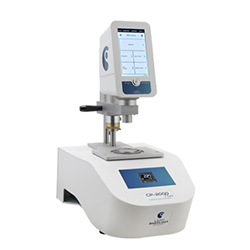
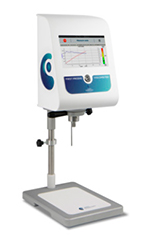
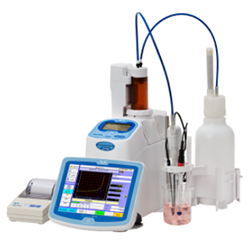


Analysis of surfaces and interfaces of samples
Continue reading →Concepts such as wettability, friction, and sample adhesion are of interest for a wide variety of applications (wear resistance of a mechanical component, the adhesion of a plaster to skin, the application of paint to a surface), but they are all closely related to a specific aspect of the sample: its surface, or interface. Below, we will attempt to define these concepts and explain the methods by which they can be characterized.What are surfaces and interfaces and what are their characteristics
We are all familiar with the states of matter: solid, liquid, and gas (we will not mention the plasma phase to avoid complicating matters).
The surface or interface is a portion of matter that separates two phases. A solid body is separated from the air around it by its surface; between two immiscible liquids, an interface creates a clear separation. These portions of matter are not only clearly definable visually, but also have different physical characteristics than the bulk of the same phase. To understand this, just consider that the molecules in the bulk of a liquid will attract each other on average in every spatial direction, while those at the edge of the phase will only be able to partially interact with the other molecules.Rheology
Continue reading →Branch of physics that aims to describe, explain, measure, and study the mechanical phenomena that occur in materials when they are deformed.
In this sense, rheology studies the deformation and flow of materials.The primary objective of a rheological study of a material is therefore the search for a relationship that defines its mechanical behavior.
It is usually indicated with the name of constitutive equation or also rheological equation of state of the material considered and links the dynamic quantities (stress) to the kinematic ones (strain).A material’s nature (liquid, semi-solid, or solid) can be classified based on its response to an external stress. The material can flow, deform partially, or remain unchanged.
At the end of the external stress, three responses can occur from the material in question:- A continuous, infinite, no longer recoverable deformation: the material flows (liquid)
- A deformation that remains totally or partially after the stress is removed: plastic or viscoelastic materials
- A deformation that is completely recovered at the end of the stress: elastic materials.
Viscometers – Choosing a Viscometer
Continue reading →A viscometer is aninstrument suitable for measuring the viscosity of fluids.
But what fluids?
From a physical/rheological perspective, a viscometer can only measure the viscosity of Newtonian fluids.
Other products, pseudoplastic and especially plastic, should not be measured with a viscometer, but with a rheometer. These products exhibit a viscosity that decreases with varying stresses or even (in the case of plastic samples) exhibit a yield point.
The rheological properties of these samples can only be measured with a rheometer.There are various types of viscosimetri, tube or capillary, cup, rotational, vibrating, Hoeppler, etc.
Each of these viscometers comes with accessories that make them suitable for measuring low- or high-viscosity products. For example, rotational viscometers use rotors of different sizes depending on the viscosity of the sample or, in the case of viscometer cups, they exist with larger or smaller outlet holes.


