


Why is flash point measured?
Classifying the flammability of volatile materials according to their flash point value has been established practice for over 100 years. Flash point requirements are listed in numerous international and national health and safety regulations and in product specifications, including UN, IATA, EPA, EU and many others.
Flash point is measured primarily to assess the safety hazard of a liquid and to classify it into a recognised hazard group. This classification is used to flag a hazard and to allow appropriate precautions to be taken during production, storage, transport and disposal.
Flash point is also a key parameter used to formulate safety warnings on household cleaning products, cosmetics, polishes and many other consumer products. Changes in flash point are also used to measure the batch consistency of a material and as an indicator of possible contamination (for example, during storage) or adulteration of a material.
It is used in industry, in the cosmetics sector and in recycling/waste.
There are several types of instruments capable of performing this test according to internationally standardised methods, which must be selected based on the product to be analysed and the temperature range.
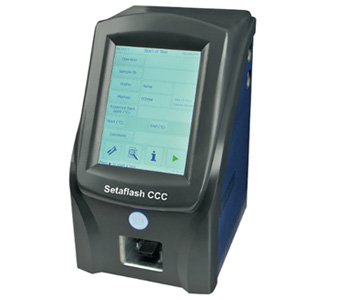
Setaflash CCC
Continuously Closed Cup Flash Point
Designed in compliance with ASTM D6450, ASTM D7094 and IP 620, it delivers fast, precise and repeatable flash point results using only 1–2 mL of sample, thereby reducing waste, operator exposure and testing costs.
The instrument combines advanced automation, integrated fire detection and extinguishing systems and intuitive touchscreen operation in a compact, modern design, and is ideal for laboratories testing fuels (including SAF), lubricants, biodiesel, solvents, chemicals, flavours and fragrances.
Setaflash CCC 35600-0:
- Wide temperature range in a single model: from -5 °C to 420 °C (down to –15 °C with external chiller)
- Unique automatic magnetic stirrer detection
- Built-in Peltier cooling for fast turnaround
- Integrated safety systems with optical flame detection
- Statistical quality control (compliant with ASTM D6299)
- Full connectivity for LIMS, Ethernet, USB and RS232
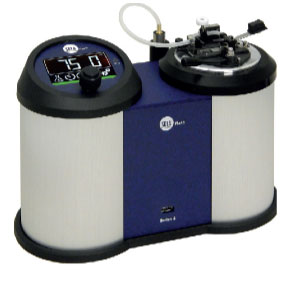
Setaflash™ Series 3e
The safest choice
- ISO 3679; 3680 (obs)
- ASTM D3278; D3828; D7236; D8174; EPA 1020 A & B
- IP 523; 524; 534; BS 2000-523

Setaflash™ Series 3
Setaflash Small Scale Flash Point Testing
- ISO 3679; ISO 3680 (obs); ISO 9038
- ASTM D3278; D3828; D4206; D7236; D8174; EPA 1020 B; SW-846
- IP 523; 524; 534; 602; BS 2000-523
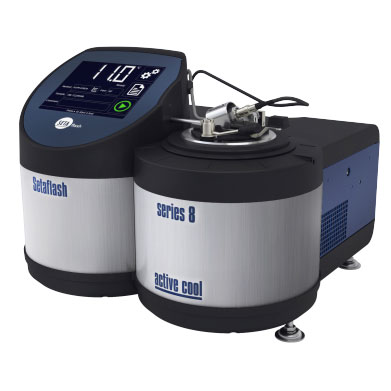
Setaflash™ Series 8 Active Cool
The safest choice
- ISO 3679; 3680 (obs)
- ASTM D3278; D3828; D7236; D8174; EPA 1020 A & B
- IP 523; 524; 534; BS 2000-523
SETAFLASH APPLICATIONS
Below are detailed PDFs covering Setaflash applications in industry, cosmetics and recycling/waste.
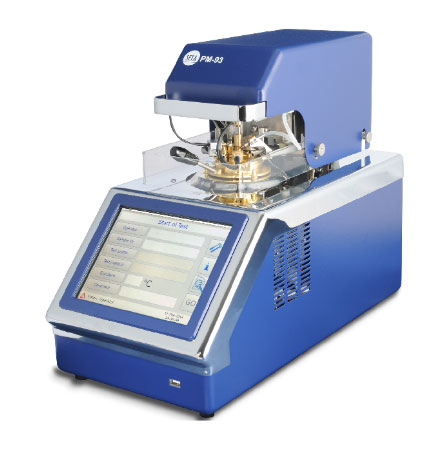
Seta PM-93
Automated Pensky-Martens Flash Point
- ASTM D93 Procedures A, B & C
- IP 34 Procedures A, B & C
- ISO 2719 Procedures A, B & C