


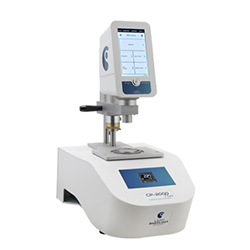
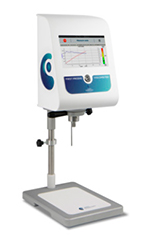
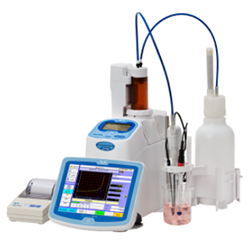




A viscometer is aninstrument suitable for measuring the viscosity of fluids.
But what fluids?
From a physical/rheological perspective, a viscometer can only measure the viscosity of Newtonian fluids.
Other products, pseudoplastic and especially plastic, should not be measured with a viscometer, but with a rheometer. These products exhibit a viscosity that decreases with varying stresses or even (in the case of plastic samples) exhibit a yield point.
The rheological properties of these samples can only be measured with a rheometer.
There are various types of viscosimetri, tube or capillary, cup, rotational, vibrating, Hoeppler, etc.
Each of these viscometers comes with accessories that make them suitable for measuring low- or high-viscosity products. For example, rotational viscometers use rotors of different sizes depending on the viscosity of the sample or, in the case of viscometer cups, they exist with larger or smaller outlet holes.


Indeed, if you use the same rotational viscometer, but change the impeller or the glass containing the sample, the viscosity value read changes.
Therefore, when using a viscometer, it is essential to specify the measurement conditions, such as the rotor used, the rotation speed (in the case of rotational viscometers), the type of beaker used, etc.
This is true for non-Newtonian products, which is the vast majority of commonly used products. Newtonian products (water, oil, honey, milk, and a few others) can also be measured by viscometers, and the measurements can also be compared.
With a rheometer, these limitations disappear. In this case, it is sufficient to specify only the velocity gradient. and measurements made with different rheometers and measuring systems will be perfectly comparable.
Generally, the most common rotational viscometers use a simple spiral metal spring as a stress transducer, which compresses (almost linearly) as the stress increases. There is a “soft” spring for the L models (for low-viscosity products), a slightly “stronger” one for the R models (for medium/high-viscosity products), and finally an even “harder” one for the H models (for very viscous samples).
Questa tecnica limita molto il campo di utilizzo di questi semplici strumenti, in particolare per quanto riguarda la sensibilità “in basso”.
Rotational viscometers are typically distinguished by type: L (Lo-Vi, low viscosity), R (Me-Vi, high viscosity) o H (Hi-Vi, very high viscosity).
An L-type viscometer can only use L impellers and not R or H impellers, and vice versa. An R-type viscometer cannot use L or H impellers, etc. Furthermore, the torque range of these viscometers is very narrow. This severely limits the use of these instruments.
An innovative technique consists of using a current-driven linear motor instead of a spiral spring. As the force exerted by the sample varies, the motor delivers a corresponding current. A dedicated transducer converts the delivered current into torque (or shear stress, depending on the measurement system used).
This allows for a large measurable torque range, approximately 5 times that of a spring instrument (and therefore a large viscosity range), combined with good sensitivity even at low viscosities.
The great advantage of this technique is that all available rotors can be used with the same instrument, i.e. L, R, H, DIN type, coaxial cylinders, flat/cone, etc.
For more information or to understand which type of instrument is best suited to your needs, contattateci: Our qualified staff will analyze your needs to find the best solution.