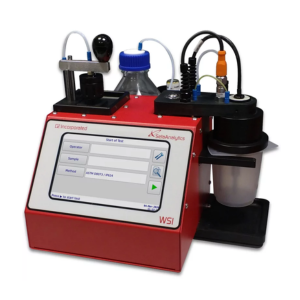


WSI ANALYSER, Water Separability Instrument, water separation analyzer
Continue reading →21 Febbraio 2024 Aggiornamenti Standard
ASTM D8073; IP624
Defense Standard DEF STAN 91-091 now includes WSI-ASTM D8073, IP624 as an alternative test for water separation at the point of production.
JIG Bulletin 150 issued – the preferred method for testing fuels containing a static dissipative additive (SDA) downstream from the point of production is now WSI-ASTM D8073, IP624. ASTM D1655 permits the use of WSI-ASTM D8073 as a downstream test for fuels.We are pleased to announce the inclusion of ASTM D8073 in DEF STAN 91-091 Edition 16, Table 5 as an alternative
to ASTM D3948 for measuring water separation in aircraft turbine fuels at the point of production.JIG Bulletin 150 has now been released with updated information on the use of ASTM D8073, IP624 and confirming that:
The preferred method for testing fuels containing a static dissipative additive [SDA] downstream from the point of production is ASTM D8073
Setaflash Small Scale, Automatic Flash Point Tester: Questions and Answers
Some methods (e.g., ASTM 8174 and EPA 1020) state that the method itself is not applicable to wastes that form a surface layer. What types of waste does this statement apply to?
 Given that ASTM D8174-18 covers the procedure for the flash point, in the range of –20 to 70°C, of liquid wastes, using a small scale closed cup tester, therefore capable of cooling to temperatures below -20°C, the instrument is compliant.
This test method is not applicable to liquid wastes that form a surface film, see Test Method D8175 for the determination of the flash point of wastes using the Pensky-Martens closed-cup tester.
This test method covers the procedure for a flash point test, in the range of 20 to 70°C, of liquid wastes using a manual or automatic Pensky-Martens closed-cup tester.The difference between Pensky-Martens and small scale is: PM, about 80 ml of sample + stirring (https://www.stanhope-seta.co.uk/wp-content/uploads/35000-0_PM-93_Flashpoint.pdf).
Continue reading →