





What are surfaces and interfaces and what are their characteristics
We are all familiar with the states of matter: solid, liquid, and gas (we will not mention the plasma phase to avoid complicating matters).
The surface or interface is a portion of matter that separates two phases. A solid body is separated from the air around it by its surface; between two immiscible liquids, an interface creates a clear separation. These portions of matter are not only clearly definable visually, but also have different physical characteristics than the bulk of the same phase. To understand this, just consider that the molecules in the bulk of a liquid will attract each other on average in every spatial direction, while those at the edge of the phase will only be able to partially interact with the other molecules.

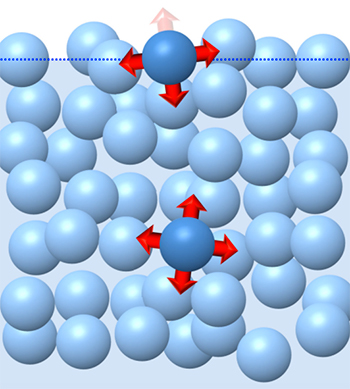
This difference will lead to a surplus of energy on the surface of the phase. This surplus of energy can be expressed as energy per unit surface area.
$$\left(\frac{J}{m^2}\right)$$
or force per unit length
$$\left(\frac{N}{m}\right)$$
and is called surface tension and surface free energy, for liquid and solid phases, respectively. A completely similar argument can be made at the interface between two liquid phases, which is called interfacial tension. Every liquid material in air will have a specific value of surface tension, just as any solid in air will have a specific value of surface free energy.
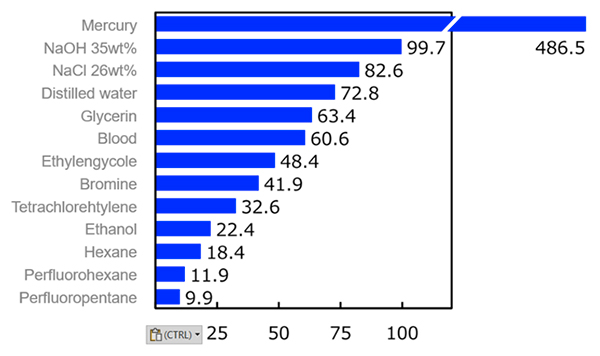
Any physical system will tend to have the lowest possible energy surplus. Therefore, a thorough analysis of these physical properties will allow us to explain and predict the behavior of these samples in various applications.
Wettability of a Solid Surface
A generic solid sample will have a well-defined surface, characterized by a certain surface free energy. When a drop of a specific liquid comes into contact with this surface, it will assume the best shape to minimize the total energy surplus of the sample-liquid-air system. If contact between the liquid and the sample leads to an overall decrease in the system’s energy, the liquid will tend to cover as much of the solid’s surface as possible: the sample will be well wetted by the specific liquid. This is the desired effect for a liquid adhesive so that it can be easily applied to a given surface. However, when the energy due to the interaction between the liquid and the solid is too high, the liquid will tend to reduce its contact area with the solid, resulting in poor wettability of the latter. This is the case of a material treated to be hydrophobic, on which (as the name suggests) water tends not to reside, instead forming almost spherical drops that can be easily removed.
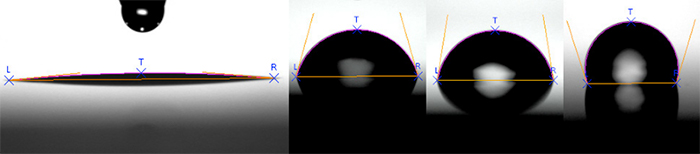
The wettability of a surface with a certain liquid can be analyzed by measuring the contact angle that a drop of that liquid assumes on the surface: the greater the contact angle, the worse the wettability. A contact angle measurement is usually obtained with specific instruments equipped with a camera to capture the drop and analysis software that can recognize its profile relative to the surface. These instruments can also analyze the drop on an inclined surface (for example, to verify how the inclination of a windshield affects the flow of raindrops), as well as a dynamic analysis of the drop, that is, how it evolves due to evaporation, absorption, and other effects. Depending on the needs and applications of interest, the best configuration for this instrumentation can be chosen.
Surface and interfacial tension of liquids
Since surface and interfacial tension are intrinsic properties of a specific liquid (or of the interface between two liquids), there are many cases in which it may be interesting to measure the surface tension value of a liquid or the interfacial tension between two liquid phases: in fact, from this measurement it is possible to infer the composition of these phases in a quality control analysis. This may be the case for liquid solutions, which will give different surface tension values depending on their concentrations; or the case of silicone or food oils, whose degree of oxidation due to wear affects the surface tension value; there are many other applications for measuring surface and interfacial tension.
There are various methods for measuring surface tension. The same optical instruments that measure the contact angle can provide an estimate of this specific property of liquids, but for a more precise measurement, dedicated instruments called superficial tensiometers must be used: these instruments exploit the holding force that a body in contact with the liquid feels due to surface tension (the same force that some insect species, the Stingrays, use to skate on the surface of the water) to obtain a precise value of the surface tension of a liquid in air or between two liquid phases.

As mentioned, these values are extremely sensitive to variations in the liquid’s composition, due, for example, to the addition of surfactants to the solution, or to physical changes such as temperature variations. Surface tensiometers are therefore perfect tools for quality control of incoming materials or finished products, but they can also provide valuable information during the research and development phase of many samples.
Concluding remarks
Many other instruments exist for specific applications in the analysis of surfaces and interfaces: for adhesive samples, tear tests can be performed with constant adhesive tape inclination angles, so as to obtain an adhesion measurement that is as independent of the geometry of the problem as possible. It can often be important to identify the amount of friction of a solid body on a surface (think of the frictional wear of mechanical components) and how this can be influenced by the application of different lubricants.
For these and other aspects of the application study of surfaces and interfaces, we recommend contacting us directly.